
Trade the slab,not the card.
Long or short price indices of graded cards and whole sets — with USDC, up to 10× leverage, and an oracle nobody can front-run. Hedge the collection you own, or trade the market without buying a single card.
From a pledge to a live market in three steps
Pledge a market into existence
Anyone proposes a card, a grade or a whole set. Collectors pledge USDC to the campaign until the pot is full.
Pledgers become the house
The pot becomes that market's own vault: it takes the other side of every trade and earns fees, funding and trader losses.
Trade the index, long or short
Up to 10× leverage on real sold prices. Hedge the slabs in your safe, or trade the market without owning a card.
A trading desk for the hobby
Live index charts, funding, open interest and a ticket that shows your fill snapshot, fee and liquidation price before you sign.
One bad market can't sink the rest
Isolated house vaults
Every market has its own vault and its own risk. If one index is manipulated or breaks, the damage stops at that vault.
Payouts reserved up front
Each position's maximum payout is locked in the vault's cash before it opens. Winners always get paid.
Forward-priced fills
Orders fill at the next snapshot. No one trades on a price they can already see.
Transparent index math
Real sold prices, fixed weights, a published formula. Every value is signed and stored on-chain.
Big moves get a second look
A jump beyond the market's threshold is held for review instead of being traded on blindly.
AI-assisted listings, deterministic prices
An AI model maps every constituent to the right product and grade, flags lots, reprints and anomalies — and never touches the number. The price comes from the formula.
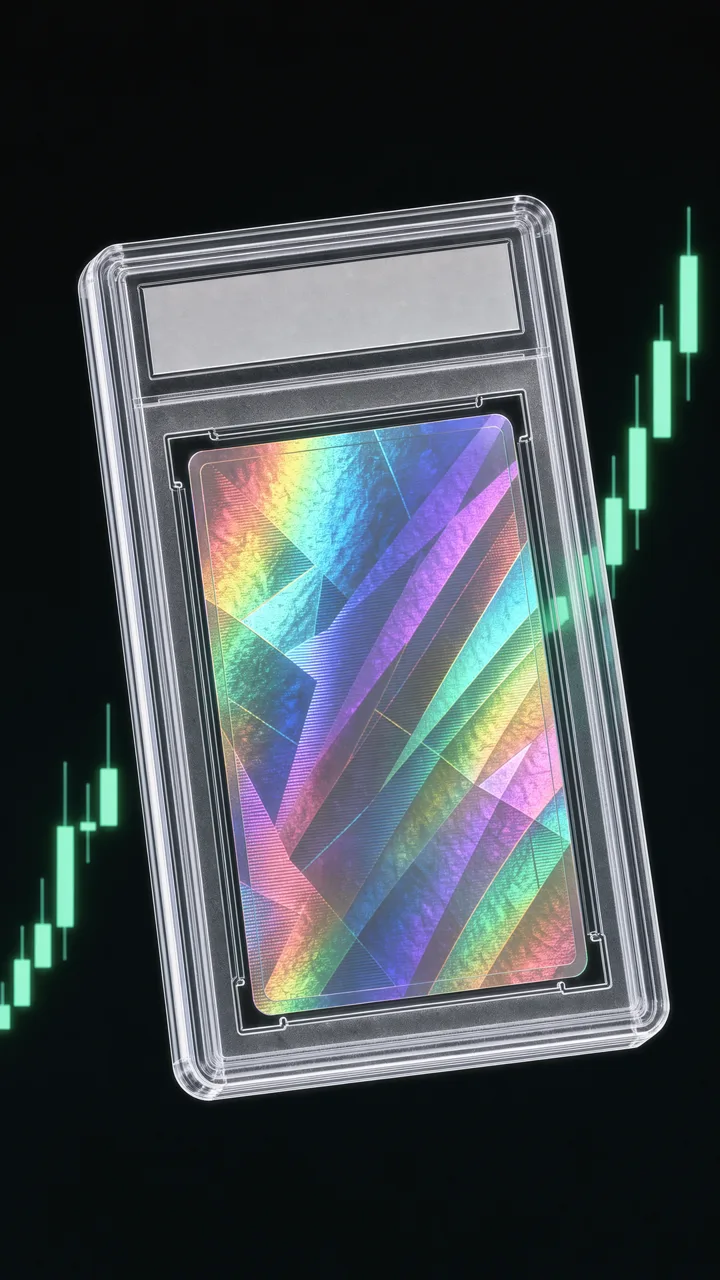
Hedge the inventory you already hold
Short the index of the set sitting in your safe. If prices fall, the position offsets the drop — without selling a single slab.

All of the upside, none of the logistics
No grading queues, shipping, fakes or storage. Trade card and set indices 24/7 from your wallet, settled in USDC.
Every trade feeds the flywheel
Most of each fee goes to the market's house. The protocol share flows to the FeeRouter, where half buys $SLAB on the open market — on-chain, with a minimum-output guard. A stronger token pulls in pledges for new markets.
Explore $SLABWhat is a slab?+
Collector slang for a graded card sealed in its protective case. Slab indices track the prices of graded cards — one card in one grade, or a basket such as a whole set.
Where do prices come from?+
Real sold prices from an established price-guide data provider, combined with a published formula whose weights are fixed at listing. Every snapshot is signed and stored on-chain.
Why can't anyone front-run the oracle?+
Your order fills at the next price snapshot, chosen when you place it — not the price on screen. Seeing a sale before the index updates gives nobody an edge.
What can the house lose?+
The house pays trader profits up to each position's reservation, which is held in cash before the trade opens. Losses are bounded and never spill into other markets.
What do I need?+
An EVM wallet (Rabby, MetaMask…) on Elysium, a little HYPE for gas and USDC.
Is it audited?+
Not yet. Treat Slab as experimental software and only use money you can afford to lose.